

IT procurement has evolved from a back-office function focused on finding the cheapest solution to a strategic process that delivers long-term business value. Driven by the shift to the cloud and as-a-Service provision, IT procurement in SMEs has become an increasingly complex task.
Get the process right, and your organisation can benefit from cost savings and efficiency gains alongside strengthened data security and improved regulatory compliance.
This article outlines a practical IT procurement framework for SMEs, explaining how one company used this approach as it shifted focus from the UK to the global marketplace.
First, we’ll explore what we mean by IT procurement and why it’s so often challenging for SMEs.
Table of contents
- What is IT procurement?
- Common IT procurement challenges for SMEs
- IT procurement best practices: A simple framework for SMEs
- When should SMEs use an IT procurement service partner?
- How the IT procurement process works in practice
What is IT procurement?
IT procurement is a strategic approach to sourcing and buying IT in line with your organisation’s financial and business goals. It includes software, hardware, and the infrastructure that supports them, such as cloud services and security solutions like firewalls.
For many SMEs, remote and hybrid working have accelerated the shift to cloud services, with more IT spend now allocated to as-a-service solutions. Buying IT is no longer a one-off transaction, but an ongoing process that includes licence renewal, vendor management, and performance monitoring.
IT procurement now depends on a clear understanding of how technology can deliver business objectives and requires close collaboration between IT, operations, and finance employees.
Common IT procurement challenges for SMEs
Often, with no dedicated procurement employee or in-house IT professional, SMEs miss out on the benefits that a strategic process brings. The most common challenges include:
Focusing on costs, not the total cost of ownership
Organisations may overlook:
- High renewal charges when free trials come to an end, or when contracts automatically renew.
- Costs of implementing multiple systems and training employees.
- Time and complexity of integrating software that’s incompatible with existing systems.
- Paying for licences for software that is no longer used (over-licensing). Alternatively, putting your company at risk of software agreement violations (under-licensing).
- The financial implications of data security risks and compliance issues.
A Total Cost of Ownership (TCO) approach takes these hidden expenses into account and assesses the cost of a solution over its entire lifetime.
Prioritising short-term fixes over long-term strategy
Without a centralised procurement system, different business functions may buy IT on an ad hoc basis to meet a specific need. These ‘tail-spend’ purchases have been estimated to make up to 20% of total spend and involve 80% of all suppliers.
This contributes to ‘vendor fragmentation’, with a large number of suppliers increasing the administrative burden. It also creates unnecessary IT complexity, and if software isn’t bought with interoperability in mind, it risks creating data silos.
Limited visibility of IT usage, leading to unnecessary expense
Before purchasing new IT, it’s important to understand what the organisation is already paying for and what employees are actually using.
A licence audit will help clarify this. Without it, companies risk costly duplication of the same or similar products and over- or under-licensing.
Increased exposure to third-party risk
Vendor fragmentation increases an organisation’s digital supply chain, with every link in that chain creating a potential security vulnerability. With insufficient visibility of the IT being bought and used in an organisation, it’s almost impossible to vet all suppliers against regulatory compliance and data protection standards.
If employees are struggling to meet business goals with existing IT, they’re more likely to turn to ‘Shadow IT’. These are systems and software used within the organisation for business purposes, but without IT’s knowledge. They operate outside company policies, putting regulatory compliance and security at risk.
By implementing a tried-and-tested framework, SMEs can overcome many of these challenges, reduce their external expenditure, while increasing the value their IT budget delivers.
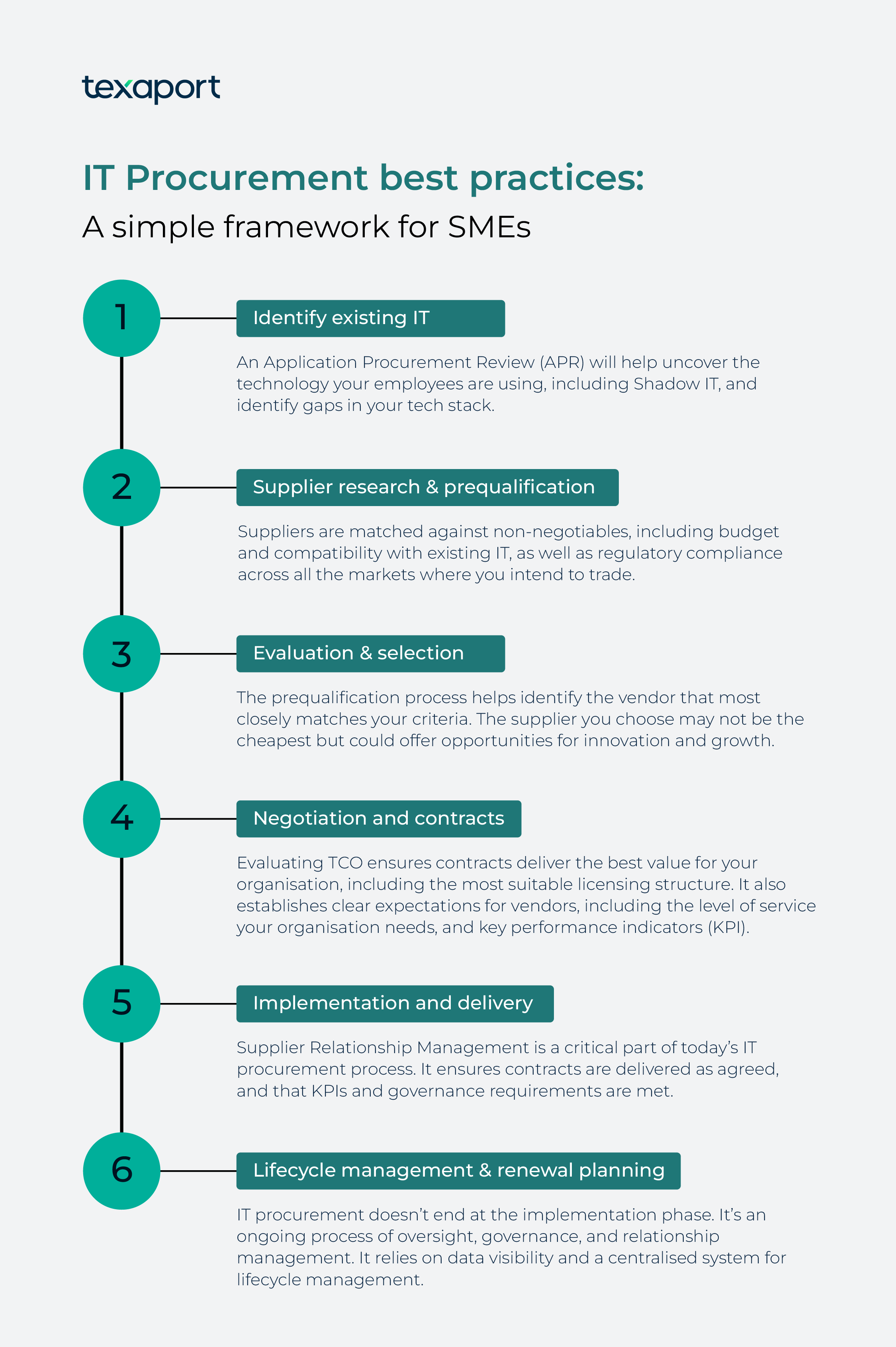
IT procurement best practices: A simple framework for SMEs
1. Identify existing IT
An Application Procurement Review (APR) will help uncover the technology your employees are using, including Shadow IT, and identify gaps in your tech stack.
2. Supplier research & prequalification
Suppliers are matched against non-negotiables, including budget and compatibility with existing IT, as well as regulatory compliance across all the markets where you intend to trade.
In the prequalification process, each vendor is assessed against core criteria, such as data transparency, ESG requirements, reliability, and customer reviews.
3. Evaluation & selection
The prequalification process helps identify the vendor that most closely matches your criteria.
The supplier you choose may not be the cheapest, but could offer opportunities for innovation and growth. A supplier with rigorous compliance and data protection processes avoids hidden costs, including the financial and reputational risks of a data breach.
4. Negotiation and contracts
Evaluating Total Cost of Ownership (TCO) ensures contracts deliver the best value for your organisation, including the most suitable licensing structure. It also establishes clear expectations for vendors, including the level of service your organisation needs, and key performance indicators (KPI).
5. Implementation and delivery
Supplier Relationship Management is a critical part of today’s IT procurement process. It ensures contracts are delivered as agreed, and that KPIs and governance requirements are met.
It also ensures that systems are correctly configured and employees are trained to get the most from their software.
6. Lifecycle management & renewal planning
IT procurement doesn’t end at the implementation phase. It’s an ongoing process of oversight, governance, and relationship management. It relies on data visibility and a centralised system for lifecycle management.
This avoids unnecessary downtime, compliance issues, and pricing structures that no longer offer value.
When should SMEs use an IT procurement service partner?
Today, IT procurement depends on strong negotiation skills alongside specialist knowledge across multiple functions. It requires a clear understanding of software and systems, and how they can support business goals. Vetting processes rely on in-depth knowledge of GDPR and data protection regimes. It takes time and technical expertise to unify fragmented IT and create a centralised procurement system.
Yet most SMEs don’t have a dedicated procurement department or an in-house IT specialist. It’s why many businesses are turning to a Managed Service Provider (MSP) like Texaport for IT consultancy or IT procurement as part of managed IT services packages.
Let’s look at how this partnership worked for one SME focused on global growth.
How the IT procurement process works in practice
IT fragmentation hampers expansion plans
Scattered, disconnected systems often become more apparent when organisations experience rapid growth. If the business expands into new markets or acquires other companies, unifying these systems is a prerequisite for a streamlined IT system and an efficient, cost-effective procurement process.
This was exactly what UK learning and development company, Mindtools, discovered when it acquired Australian company, Kineo. The merger had enormous potential to create a company with global impact, but it soon became clear that significant IT fragmentation was holding them back. As Mindtools’ long-established IT partner and MSP, the newly merged company approached Texaport to help them smooth the transition.
Streamlined IT leads to effective IT procurement
With extensive experience supporting SMEs and providing global IT support, Texaport’s first step was to unify the company's IT infrastructure. This allowed the business to combine the strengths of the merged companies and rationalise the IT procurement process.
Centralised control and management were key. IT fragmentation was reduced by introducing Microsoft 365 and consolidating cloud platforms. This provided a ‘Single Source of Truth,’ a solid foundation for enhanced data visibility and governance.
| IT procurement framework | IT procurement in practice | |
| 1 | Identify existing IT | With improved visibility, Texaport initiated an APR to align applications with business goals. Only applications that supported core business needs, financial goals, and compliance standards were kept. |
| 2 | Supplier research and prequalification | By consolidating cloud platforms, Texaport could introduce a Federated IT Governance Model with governance, controls, and standards, such as NIST, established centrally. Within this structure, teams in each location had the freedom to respond to local needs. |
| 3 | Evaluation & selection | With improved visibility, IT procurement teams could take a data-driven approach to supplier selection. This transparent, measurable process smoothed the transition to the new system across the organisation. |
| 4 | Negotiation and contracts | By cutting the number of applications, vendor fragmentation was reduced. Mindtools could negotiate more favourable contracts, reducing overall spend. |
| 5 | Implementation and delivery | With centralised procurement comes automation and efficiency gains. Managing fewer suppliers, teams spent less time on administration and redirected their time to higher-value tasks. |
| 6 | Lifecycle management & renewal planning | Texaport centralised and automated the software licensing process for tools such as Adobe, improving oversight while reducing under- and over-licensing. |
The ongoing shift to the cloud, subscription models, and the growth of everything-as-a-Service have transformed IT procurement. It is no longer about “buying IT cheaper,” but about managing suppliers, risk, and Total Cost of Ownership. This can only be achieved through unified systems, visible data, and centralised governance.
A proven MSP has the IT knowledge to establish these foundations and the experience to implement a strategic IT procurement framework. Take the first step to more cost-effective, streamlined IT procurement by speaking to Texaport.